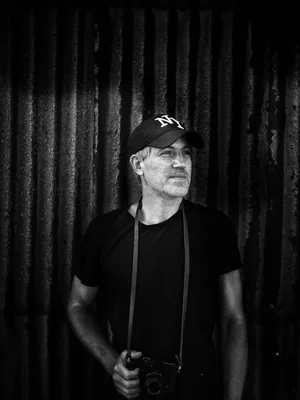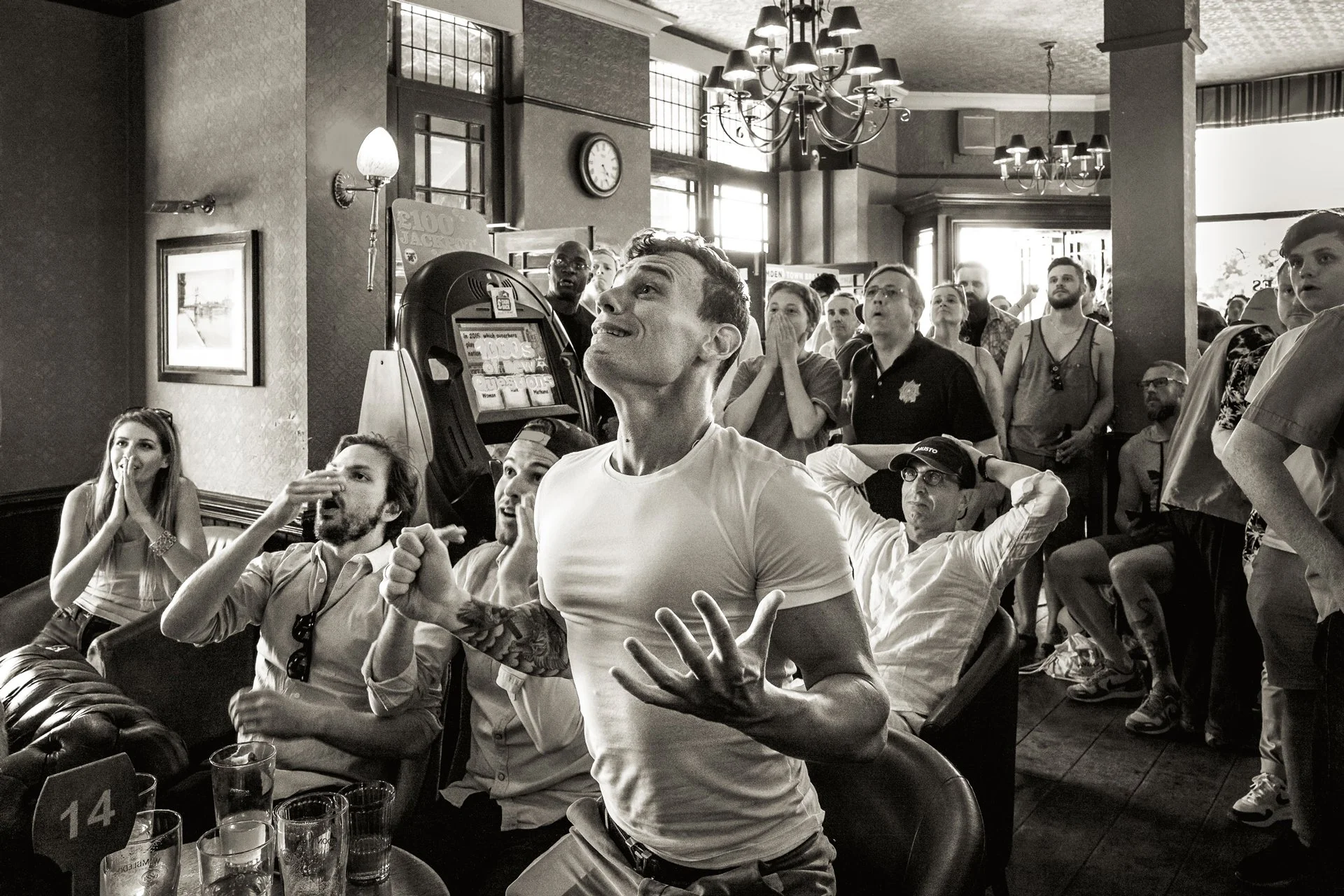
© Mike Taylor – from the series “Watching People Watching Football In Pubs”
Football is one of the most photographed subjects in the world. Most photographers focus on the action, the goals, or the players. British photographer Mike Taylor chose a very different perspective. Since the 2018 World Cup, he has been photographing football fans in British pubs — not the match itself, but the anticipation, tension, joy and heartbreak unfolding on the faces of those watching. In this conversation, he explains how a chance encounter became an award-winning long-term project and why some of the strongest documentary stories are found by looking away from the obvious.
„I’ve never intended or planned to shoot football crowds in pubs, I stumbled upon this fantastic oppportunity for people watching quite by accident. To be completely honest, I don’t follow football and never actually have.“
When the Real Story Isn't on the Pitch
Some photographers travel across the world in search of extraordinary stories. Others, like Mike Taylor, discover that compelling stories can be found much closer to home—if you're willing to look at familiar subjects from an unexpected angle. At first glance, Taylor's series Watching People Watching Football in Pubs seems remarkably simple. There are no famous players, dramatic tackles or winning goals. Instead, his camera is turned towards the audience. We see people frozen in anticipation, erupting with joy, burying their faces in their hands or embracing complete strangers. The football match itself never appears in the frame. That absence is precisely what makes the work so powerful.
Rather than documenting sport, Taylor is documenting something far more universal: shared emotion. His photographs are about hope, disappointment, belonging and the fleeting moments when people become so absorbed in an experience that they completely forget about the world around them.
What makes this even more remarkable is that Mike Taylor has never been interested in football.
„I’ve never followed a team. I’ve never been interested in football.“
At first, that seems almost contradictory. Looking at his photographs, many people naturally assume that he must be a devoted football supporter. Instead, he describes himself as someone who has always felt disconnected from the sport, despite friends repeatedly trying to convince him otherwise: "It's great being amongst tens of thousands of people screaming and cheering. But emotionally, it just doesn't do a thing for me."
Ironically, that emotional distance became one of his greatest strengths as a photographer. Because he isn't watching the match, he is free to observe everything happening around it. His attention shifts from the ball to body language, from tactics to facial expressions, from sport to humanity. It is an important reminder that documentary photography often begins with a simple shift in perspective. Sometimes the most interesting story is unfolding just outside the frame everyone else is looking at.
A Chance Photograph That Changed Everything
Many long-term projects begin with years of planning. Mike Taylor's did not. During the 2018 World Cup, he happened to walk into a pub packed with football supporters. The only available seat was the one with no view of the television screen. For most people, that would have been the worst place in the room. For Taylor, it became the perfect vantage point. Instead of watching the match, he found himself watching hundreds of people watching the match. He instinctively picked up his camera. Not because he already had a project in mind, but because something about the scene felt visually rich and emotionally charged: “Here is a fantastic subject for photography.”
That afternoon he made roughly 800 photographs. Most of them were unremarkable. Some failed completely. But while reviewing the images later, one photograph immediately stood out.
„There’s one that just jumps out at you. It literally leapt off the screen.“
That single image would later win the CEWE Photo Award in the Street Photography category and become the foundation of an ongoing body of work. Yet for Taylor, the award was almost secondary. The real breakthrough was recognising that one successful image could become the beginning of something much larger.
Instead of moving on to another subject, he returned.
Another tournament.
Another pub.
Another crowd.
Slowly, a visual language began to emerge.
Great Projects Often Begin With a Single Question
We often make strong individual photographs without realising that they might belong to a larger story. Only later do we begin to notice recurring themes, visual patterns or questions worth pursuing over time. Taylor's experience illustrates that perfectly. His series did not begin with a carefully written project proposal or a detailed concept. It began with curiosity—and with the willingness to return to the same subject again and again. That persistence is perhaps one of the strongest lessons from this conversation.
Many photographers spend years searching for extraordinary locations or exotic stories. Mike Taylor stayed with a single idea and discovered that repetition did not make the work predictable. Instead, it revealed new layers of meaning. Each tournament became another opportunity to photograph anticipation, celebration, frustration and silence. The football itself remained almost irrelevant. His photographs remind us that the strongest documentary projects are rarely about the obvious subject. They are about what that subject reveals about people.
Reading the Crowd: Why Patience Matters More Than Speed
At first glance, Mike Taylor's photographs seem spontaneous—as if they were made in the split second when emotion erupts. But listening to him describe his process reveals something very different. Behind every successful frame lies careful preparation, quiet observation and an understanding of how crowds behave. His photographs are not the result of luck. They are the product of patience. Taylor has developed a remarkably consistent routine. Before every match, he arrives early, long before the atmosphere reaches its peak. He walks through the pub, studies the layout, looks at the position of the television screens and begins to observe how people naturally gather. Finding the right location is the first decision—and one that cannot easily be corrected later.
„I think you have to kind of make your decision. Sometimes you pick the wrong spot... but you’re not going to be getting up, blocking the screen and walking across a busy pub in the middle of a game. “
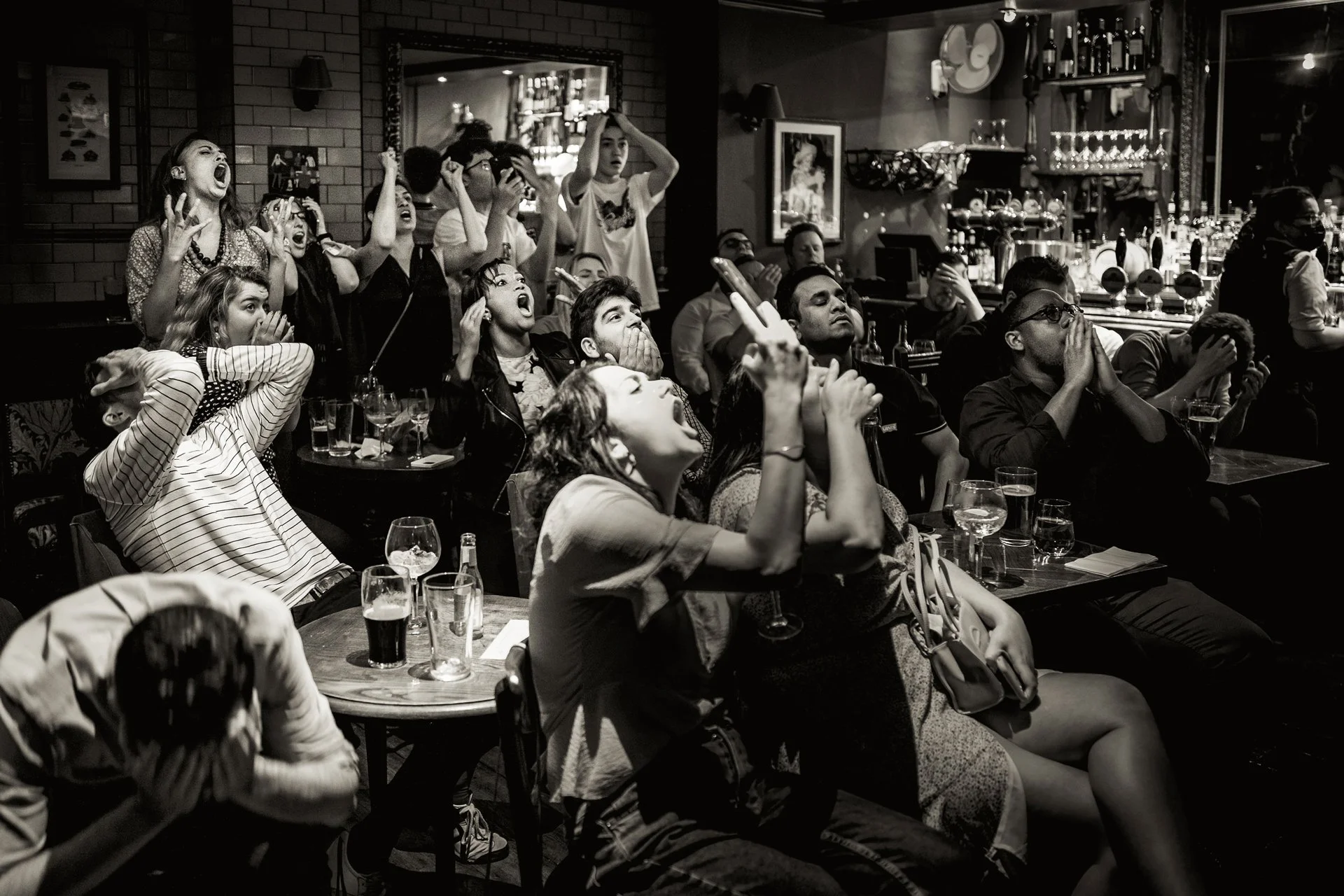
© Mike Taylor – from the series “Watching People Watching Football In Pubs”
Once he has chosen his position, he stays there. Rather than chasing moments, he allows them to come to him.
This is perhaps one of the strongest lessons from the interview. Many photographers instinctively move through a scene, constantly searching for better compositions. Taylor does the opposite. He commits to one viewpoint and invests his attention in understanding what is happening within that small section of the room.
Every Crowd Has Its Own Story
One of the most fascinating parts of the conversation is Taylor's description of how he "reads" a crowd. He explains that every group contains certain characters who naturally shape the dynamics around them. There is almost always one person who becomes the emotional centre—the unofficial leader whose reactions influence everyone nearby. Finding that person is one of the first things he does.
„Find your hero.“
That individual becomes the anchor of the photograph. The surrounding people create the context, but the emotional narrative often begins with one expressive face. Even more intriguing is another pattern he has discovered after photographing football crowds for years. Someone in every group reacts a fraction of a second before everyone else: "They're always the first person to move." That early reaction becomes his signal. It provides the tiny window of time he needs to anticipate what will happen next, rather than simply reacting after the decisive moment has already passed. Taylor connects this directly to one of David Hurn's best-known observations about photography:
„Photography is about two things—knowing where to stand and when to press the shutter.“
His process, therefore, is less about fast reflexes than about careful anticipation. The decisive moment is not something he chases. It is something he prepares for.
Becoming Invisible
One question naturally arises when looking at Taylor's work: how is it possible to photograph people from such close distances without disrupting the scene? His answer is surprisingly simple: He does not hide. Nor does he make a dramatic entrance. Instead, he tries to become part of the environment. Often, he orders a pint, places it on the table and quietly settles into the pub like everyone else. If people ask what he is doing, he briefly explains that he is photographing for the venue or simply shows them a few images from previous matches. Once people understand the project, curiosity usually replaces suspicion. More importantly, as soon as the match begins, he almost disappears.
„The game starts and then you become invisible.“
It is a beautiful reminder that the photographer's presence is often far less significant than photographers themselves imagine. When people are genuinely absorbed in an experience, the camera quickly becomes secondary.
Working With Emotion Instead of Perfection
Technically, Taylor's photographs are anything but perfect. He often works in almost complete darkness. During the Qatar World Cup, many pubs switched off their lights entirely, leaving the television screens as the only light source. He photographs with a 28mm lens wide open at f/1.7, frequently shooting at ISO 12,000 with shutter speeds as low as 1/30 or 1/60 of a second. Motion blur, grain and high contrast become unavoidable parts of the image. Yet he embraces those imperfections: “They're grainy, contrasty, there's blur..."
For Taylor, technical perfection has never been the goal. What matters is whether a photograph captures an authentic emotional experience. Again and again, the conversation returns to this idea. The most memorable photographs are rarely the sharpest ones. They are the ones that make us feel something. That belief also shapes the way he edits his work. Out of hundreds of photographs from a single evening, perhaps only one or two survive. He is remarkably ruthless in deciding what deserves to be shown. That discipline reflects a broader philosophy he later describes in the interview: photographers should spend less time producing more images and more time recognising which images genuinely matter.
Emotion Is the Real Decisive Moment
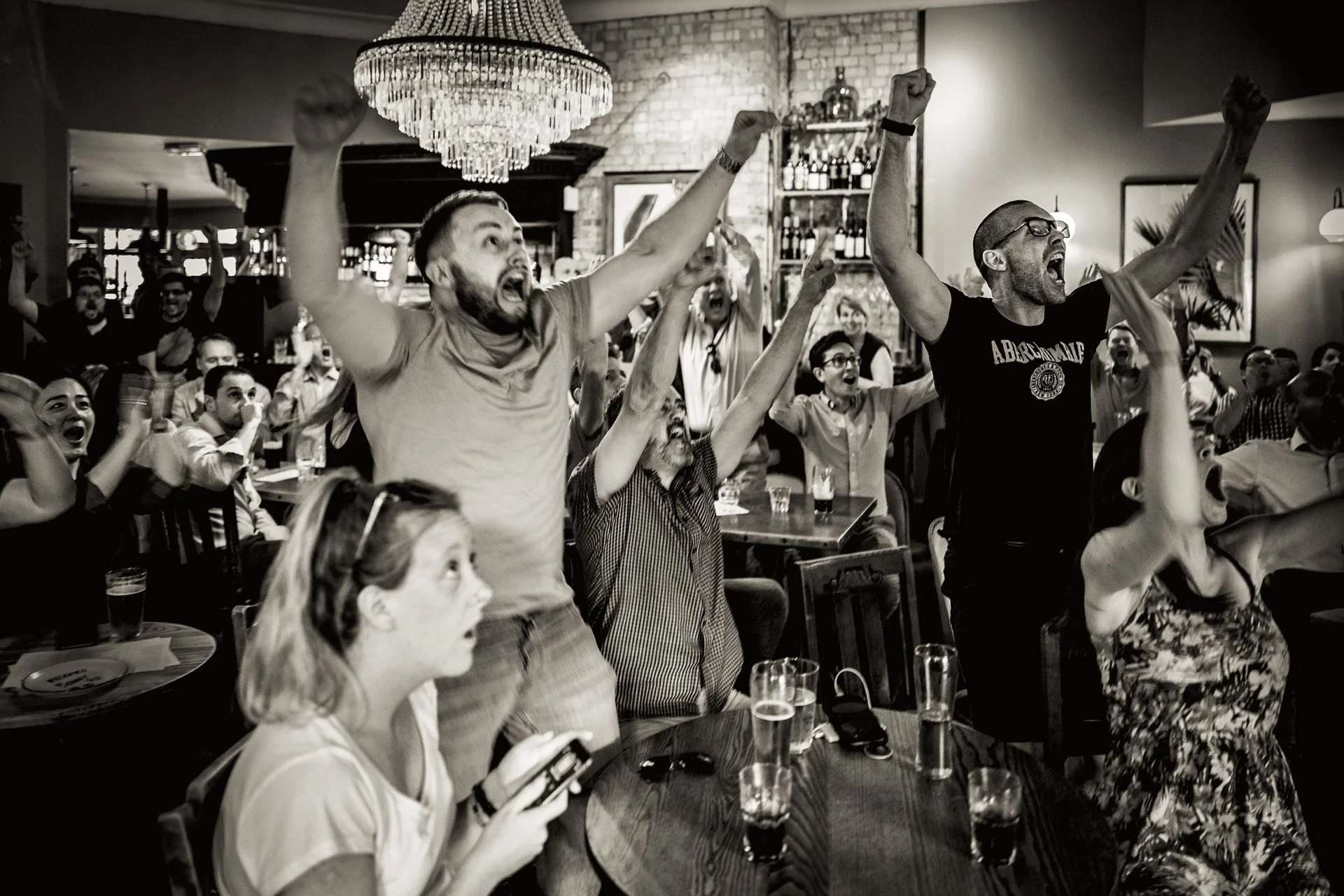
© Mike Taylor – from the series “Watching People Watching Football In Pubs”
A central idea behind Taylort’s entire project is that football is simply the catalyst. The real subject has always been emotion. He is not documenting sport. He is documenting the rare moments when people stop performing for the outside world and respond instinctively, honestly and without self-consciousness. Those are the moments his photographs preserve. And perhaps that is why the series resonates even with people who have no interest in football whatsoever. The images are not about the game. They are about being human.
Learning Photography at 55: Why Mike Taylor Started Again
One of the most inspiring parts of the conversation has nothing to do with football. It is the story of how Mike Taylor became the photographer he is today. Unlike many photographers exhibiting at international festivals, Taylor did not study photography, attend art school or build his career through formal education. Photography had always been present in his life, but mostly in the background. His professional career led him into journalism, television news, digital media and later into running a wine business with his wife. The camera was always there—but it was never his main focus.
Everything changed during a trip to Vietnam in 2018. Like many people, he had gradually replaced his camera with a smartphone. For almost a decade he photographed almost exclusively with his iPhone, convinced that its convenience outweighed any creative compromises. Then, while reviewing a photograph he had taken beside a quiet lake, he experienced what he describes as a profound moment of clarity.
„I suddenly thought, that’s what I’ve been missing.“
The realization hit him harder than he expected. "It felt like I'd wasted ten years." Rather than accepting that feeling with regret, he turned it into motivation. At the age of fifty-five, he made a conscious decision to take photography seriously—not professionally, but personally. He wanted to find out how good he could become if he committed himself fully to the craft. He compares that decision to joining a gym. Nobody expects dramatic results after a single workout. Progress comes from consistency, discipline and showing up day after day. Photography, he believes, is no different.
Becoming Your Own Teacher
Without a photography degree or formal training, Taylor built his own curriculum. He immersed himself in what he jokingly calls "YouTube University." Rather than watching endless gear reviews, he searched for photographers and educators whose way of thinking resonated with him. Among the voices that shaped his development were Ted Forbes, David Campany and David duChemin.
What attracted him was not technical instruction but thoughtful conversations about seeing, composition and visual storytelling. Looking back, it becomes clear that his education was driven by curiosity rather than obligation. He wasn't collecting tutorials in the hope of finding shortcuts. He was gradually reshaping the way he looked at photographs—including his own. That distinction matters. Many photographers spend countless hours learning how to use their cameras more efficiently. Taylor was far more interested in learning how to think more clearly about pictures.
Creative Limitations Create Better Photographs
One of the practical ideas that transformed his work was surprisingly simple. Instead of expanding his choices, he deliberately reduced them.
He chose one camera.
One lens.
One focal length.
One aspect ratio.
Today he photographs almost exclusively with a Leica Q and its fixed 28mm lens. He prefers horizontal compositions and rarely deviates from them. Rather than seeing these decisions as restrictions, he views them as creative freedom. By removing unnecessary choices, he frees himself to concentrate on timing, composition and emotion. It is an approach that echoes a recurring theme throughout the interview: great photography rarely comes from having more options. It comes from making clearer decisions.
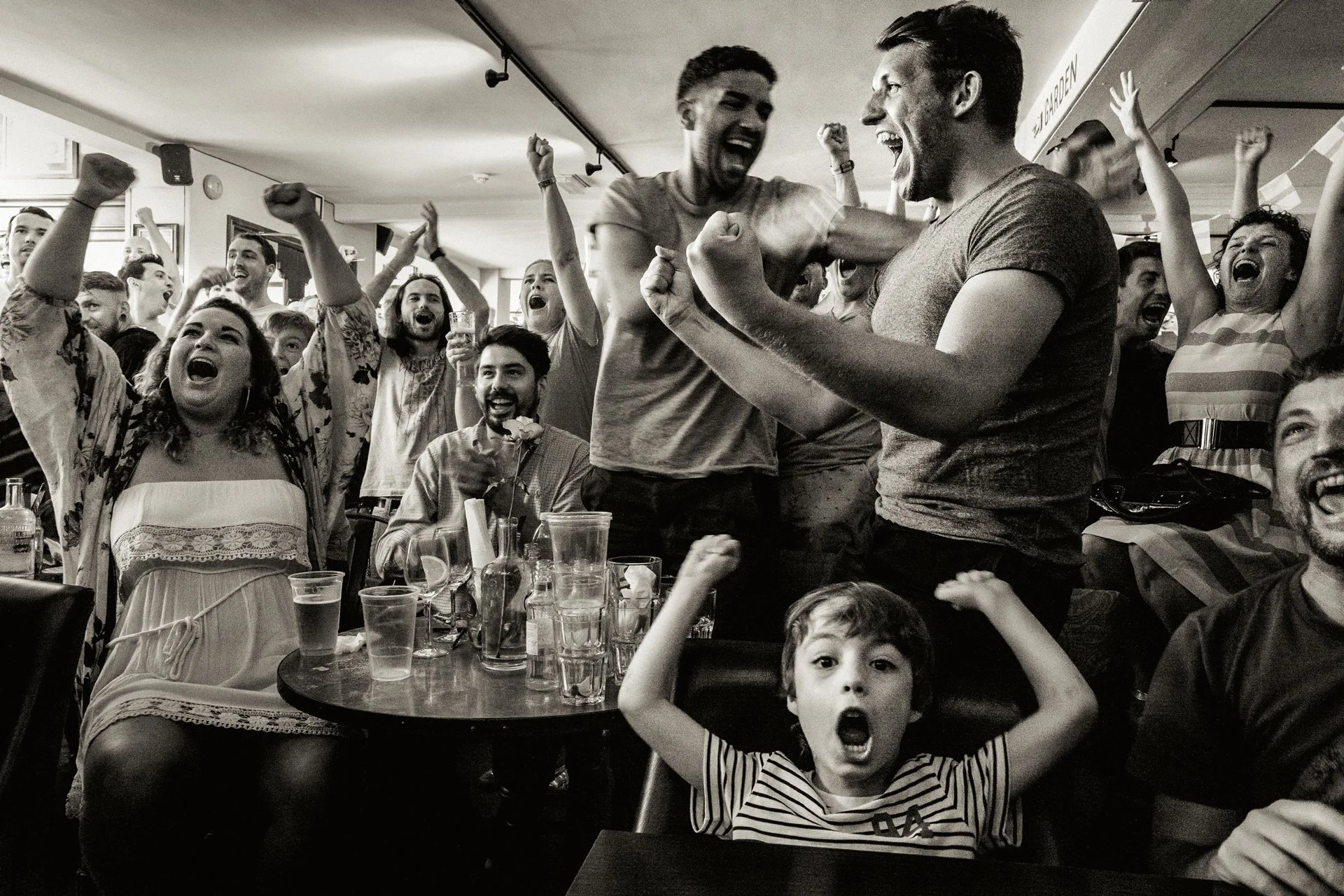
© Mike Taylor – from the series “Watching People Watching Football In Pubs”
Learning to Edit Yourself
If there is one skill Taylor considers even more important than taking photographs, it is learning how to evaluate them honestly. After making the image that would eventually win the CEWE Photo Award, he began researching something surprisingly basic: “How do you criticise your own photographs?” The answer he found became the foundation of his editing process. Every photograph, he believes, should be examined through three simple questions:
What do I see?
What do I think?
What do I feel?
The first question is descriptive. The second considers composition, aesthetics and technical execution. But the third is the one that matters most. Does the photograph create an emotional response? Or does it simply record what happened? Taylor argues that many technically competent photographs fail because they never move beyond description. By contrast, he believes the truly memorable images are those that establish an emotional connection between photographer and viewer: "When you do make a picture that makes people feel something, it is game changing."
This idea ties together everything discussed earlier in the interview. His football photographs are successful not because they document supporters watching a match, but because they communicate anticipation, joy, despair and belonging—emotions that remain meaningful even to viewers with no interest in football.
The Journey Is More Important Than the Destination
Towards the end of the conversation, Mike Taylor reflects on something that runs quietly beneath entire story: the desire to keep improving without chasing a specific destination: “The journey is definitely the important bit.” He never set out to win awards. He never expected to exhibit at one of Europe's largest outdoor photography festivals. Those opportunities emerged as consequences of the work, not as objectives. Instead, his motivation was much simpler. He wanted to become a better photographer than he had been the year before. That mindset feels increasingly refreshing in an era dominated by social media metrics, competitions and constant pressure to produce more content. Taylor repeatedly argues for the opposite approach: make fewer photographs, edit more rigorously and only share work that genuinely deserves to be seen.
His advice is wonderfully uncomplicated.
Many photographers would improve dramatically if they spent less time reading lens reviews and more time studying great photography—and their own work.
What Photographers Can Learn from Mike Taylor
Although the interview revolves around a series about football fans, its lessons reach far beyond that specific subject. At its heart, this is a conversation about developing photographic vision. Some of the strongest takeaways include:
Look beyond the obvious subject. Sometimes the most interesting story happens at the edge of the frame.
Return to the same idea repeatedly. Long-term projects grow through persistence rather than novelty.
Observe before photographing. Understanding people often matters more than reacting quickly.
Limit your tools. Creative constraints can sharpen your vision.
Edit ruthlessly. Strong photography is often defined by what you choose not to show.
Ask more from your images than technical perfection. The question is not whether a photograph is sharp, but whether it leaves the viewer feeling something. Perhaps that is the thread connecting Mike Taylor's entire body of work. He is not photographing football. He is photographing people. And ultimately, that is what documentary photography has always been about.
About Mike Taylor
Mike Taylor is a British photographer whose work explores the relationship between people, place and shared experience. Before dedicating himself to photography, he spent decades working as a journalist, in television news and digital media.
His award-winning long-term project Watching People Watching Football in Pubs focuses not on the game itself but on the emotional theatre unfolding among football supporters.
His work demonstrates how everyday situations can reveal universal stories about human behaviour, belonging and collective experience.

Du fragst, ich antworte
Im Podcast sollst du zu Wort kommen!
Hast du Fragen, spannende Themen oder einfach Gedanken, die du schon immer mal loswerden wolltest? Dann schreib mir!
Mein Q&A-Format lebt von deinen Beiträgen – und ich freue mich riesig, deine Fragen zu beantworten.
Egal, ob du Tipps brauchst, neugierig auf meine Meinungen bist oder einfach eine lustige Anekdote erzählen möchtest – dein Feedback ist herzlich willkommen!
Schick mir deine Fragen & Feedback per Mail an:
kaibehrmann@web.de und sei Teil einer der nächsten Folgen.
Keine Frage ist zu klein, zu groß oder zu verrückt – ich freue mich auf deine Ideen!
Unterstützung für den Podcast von “Abenteuer Reportagefotografie
*Bei einigen der Links auf dieser Website handelt es sich um sogenannte Affiliate-Links. Wenn du die verlinkten Produkte kaufst, nachdem du auf den Link geklickt hast, erhalte ich eine kleine Provision direkt vom Händler dafür. Du zahlst bei deinem Einkauf nicht mehr als sonst, hilfst mir aber dabei, diese Webseite für dich weiter zu betreiben. Ich freue mich, wenn ich dir Inspiration für deine Kamera-Abenteuer biete.
Falls du Danke sagen möchtest, kannst du mir per PayPal eine Spende zukommen lassen. Oder du schaust auf meiner Amazon-Wunschliste vorbei. Dort habe ich Dinge hinterlegt, mit denen du mir eine Riesenfreude machen würdest.
Herzlichen Dank für deine Unterstützung!